File Management UI
From the File Management page of the SBS portal, you can perform the following actions:
- View all files stored in SBS for the currently selected account, application, and tenant.
- Filter files by their unique SBS file ID. Since each file ID is unique in SBS, using this filter returns one result only.
- Filter files by an external reference identifier. For example, all files pertaining to an e-Factura invoice, including attachments, have the same external reference.
Access
You can access the File Management page of the portal as follows:
- Sign in to the SBS Portal. During the sign-in process, you will be prompted to select the account, app, and tenant where you are entitled to sign in.
- Click File Management in the left hand-side menu.
To interact with the File Management service, you can use either the Web UI or a GraphQL interface. You can switch at any time between the two interfaces by clicking the switch displayed at the top of the page:

View files
After you access the File Management UI, the files stored in SBS for the selected account, application, and tenant are displayed in a grid.
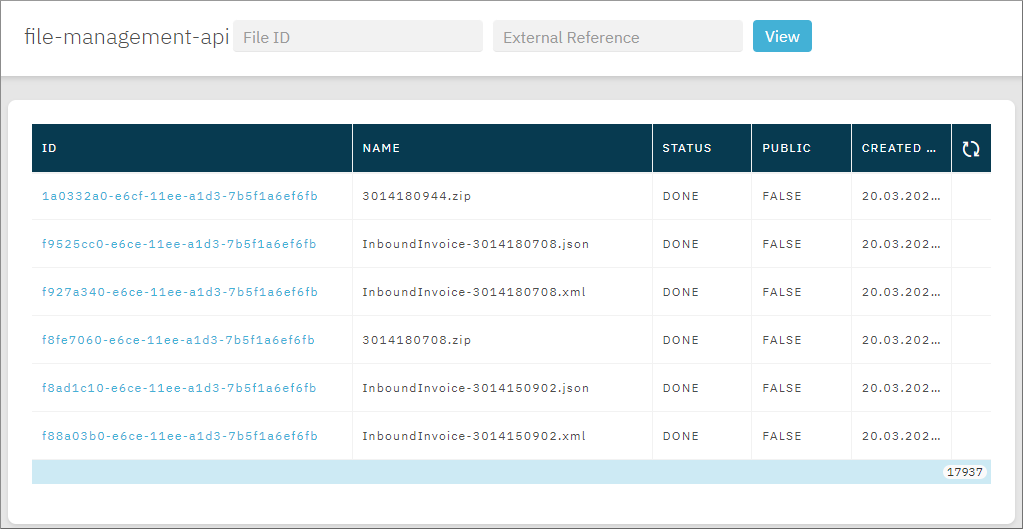
To view details about a particular file, click the file’s ID (first column) in the grid. This opens a dialog box with file details, for example:
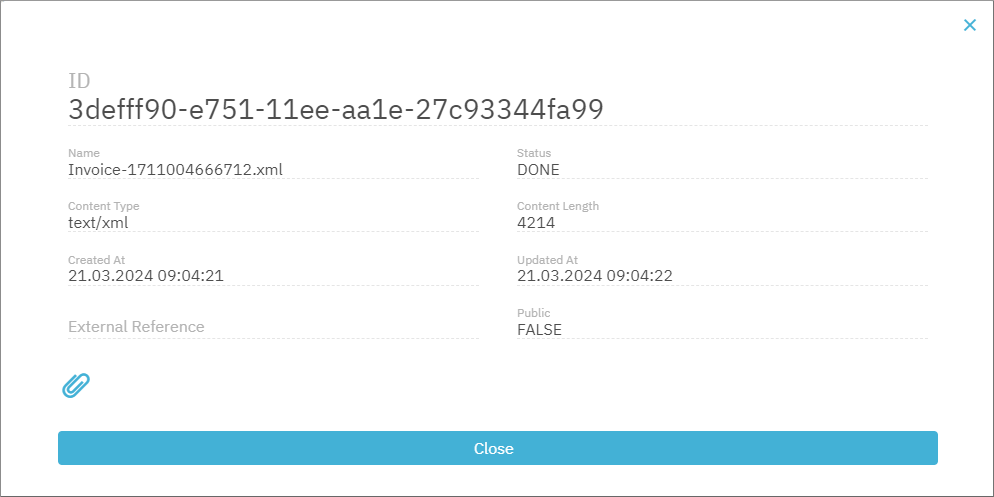
The table below shows the file fields that are exposed through the Web UI. To return a file’s full list of fields, query a file through GraphQL.
| Field | Description |
|---|---|
| ID | The unique identifier of the file in SBS. |
| Name | The file name. |
| Status | The current status of the file. Valid values: UPLOADING - File content is in the process of being uploaded; DOWNLOADING - File content is in the process of being downloaded from the provided URI; DONE - The file is ready; ERROR - An error has occurred during upload or transfer. |
| Content type | The content (MIME) type of the file. |
| Content length | The size of the file in bytes. |
| Created at | The date and time when the file was created in SBS. |
| Updated at | The date and time when the file was last updated in SBS. |
| External reference | A file may optionally have an external reference. For example, if an invoice was created through the e-Factura Service, all the files related to that invoice (such as XML, PDF, JSON, and attachments) will contain the same external reference which includes the invoice number. |
| Public | This flag indicates whether the file is accessible through a public URL or not. |
 |
Click the paperclip icon to download the file to the local disk. |
Query files through GraphQL
To query files through GraphQL
- Switch to the GraphQL interface.
- Run one of the following queries, as required:
file,files,filesWithExternalReference.
For example, the file query below retrieves full details about a single file by ID:
query($filter:FilesFilter, $downloadUrlTimeout:Int, $uploadUrlTimeout:Int) {
  files(filter:$filter){
    items {
	   id
      name
      active
      comment
      author { id name email profile }
      contentType
      contentLength
      status
      error { code message }
      createdAt
      updatedAt
      externalReference
      uploaded
      public
      downloadUrl(expiresIn: $downloadUrlTimeout)
      uploadUrl(expiresIn: $uploadUrlTimeout)
      attributes { name value }
    }
  }
}
{
  "filter": {
    "id": "YOUR_FILE_ID"
  },
  "downloadUrlTimeout": 60,
  "uploadUrlTimeout": 60
}
Create, modify, delete files
Creating, modifying, and deleting files is available only from the GraphQL interface. For details, see the File Management Service API Reference.
File storage counters in File Management Service
For File Management service, there are two counters that track storage consumed by all your files in the cloud:
- STORED_MB_PER_MONTH
- BILLABLE_MB_PER_MONTH.
To view the current values of these counters, visit the Usage Monitoring Service page and select the respective filters. Both counters above are expressed in “megabyte per month”, a unit that can is calculated based on the following factors:
- The number of files
- The size of each file
- The number of days in the current month (it can be 28, 29, 30, or 31).
Importantly, SBS uses a billing policy along the lines of AWS, where the minimum billable file size is 128KB. This means that any file that is less than 128 KB counts as 128 KB for billing purposes. This rule accounts for possible differences between STORED_MB_PER_MONTH versus BILLABLE_MB_PER_MONTH, applicable only if there are files smaller than 128 KB.
Example
Let’s suppose the current month is January. On day 1 of the month, tenant “Demo” uploads 1 file of 31MB to SBS. As a result, the storageUsed query returns:
- filesize:
32,505,856bytes - billableFileSize:
32,505,856bytes
The STORED_MB_PER_MONTH counter for this day is calculated as fileSize / daysInMonth, and then converted to MB. Given that January has 31 days, this value will be calculated as: 32,505,856 / 31 / 1024 x 1024 = 1.
If, on day 31 of the month, the tenant Demo still has the same file, the STORED_MB_PER_MONTH will have the same value 1, accordingly.